
When building or modernizing an enterprise application, one of the most important architectural decisions is choosing between monolithic architecture and microservices.
Microservices are often associated with scalability, flexibility, and modern cloud development. But that doesn't mean every enterprise needs to move away from a monolith.
The right choice depends on your product, engineering team, scalability requirements, business goals, and technology maturity.
What Is a Monolithic Architecture?
A monolithic application is built as a single deployable application where major components such as business logic, APIs, and data access are part of the same system.
A monolith can be a practical choice when:
- The product has relatively straightforward requirements
- The engineering team is small or centralized
- Operational simplicity is important
- The application doesn't require independent scaling
- Faster initial development is a priority
A well-designed monolith can be easier to develop, test, deploy, and maintain when the product is still relatively focused.
However, as the application and team grow, tightly coupled components can make independent development, deployment, and scaling more difficult.
What Is a Microservices Architecture?
Microservices divide an application into smaller, independently deployable services. Each service generally focuses on a specific business capability.
This architecture can be useful for enterprises with:
- Complex applications and multiple business domains
- Large engineering teams
- Independent scaling requirements
- Frequent releases
- Multiple teams working on different capabilities
Microservices can provide greater flexibility, but they also introduce additional complexity around APIs, networking, monitoring, security, deployment, and distributed systems.
That's why moving to microservices simply because it is considered "modern" can create unnecessary challenges.
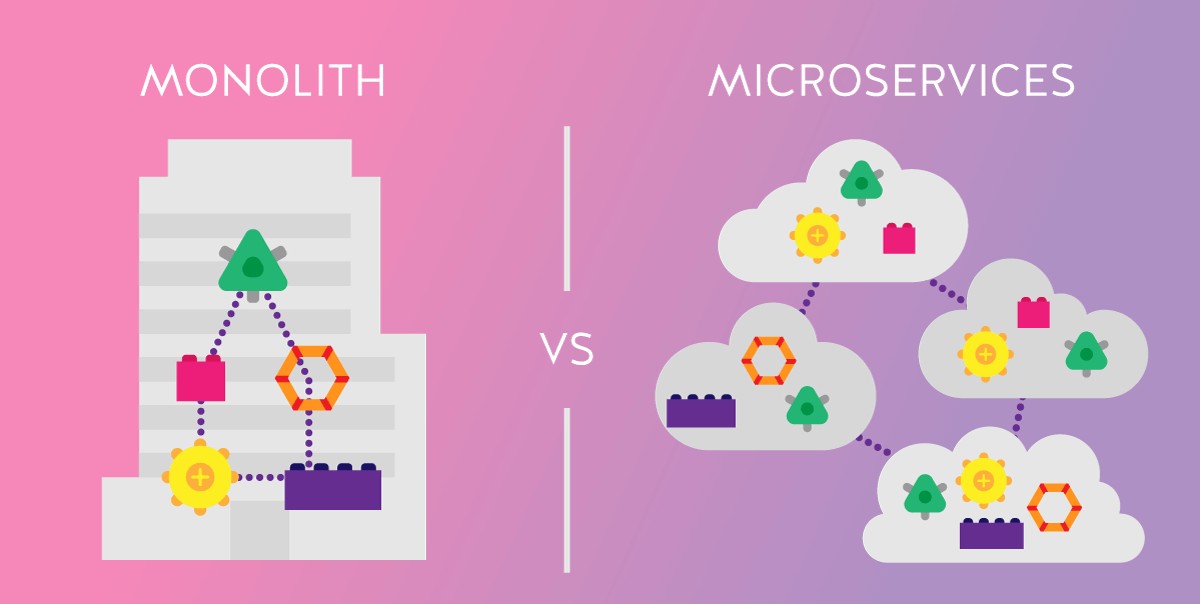
Monolith vs Microservices: What Should Enterprises Consider?
Before choosing an architecture, enterprises should look beyond technology trends and evaluate:
- Product Complexity: does your application have clearly separated business domains, or is the functionality tightly connected?
- Team Structure: a large number of microservices can become difficult for a small engineering team to manage. Architecture should support how your teams actually work.
- Scalability: if only certain parts of your application need to scale independently, microservices may provide an advantage.
- Deployment Requirements: if teams need to release different product capabilities independently, microservices can provide greater deployment flexibility.
- DevOps Maturity: microservices require strong CI/CD, monitoring, observability, cloud infrastructure, security, and incident-management practices.
Does Every Enterprise Need Microservices?
No.
For some businesses, a well-structured monolith may continue to be the right solution.
For others, microservices may provide the flexibility required for growth.
There is also a third option: incremental modernization.
Instead of completely rewriting an existing application, enterprises can identify high-value or independent components and gradually extract them into services.
Monolith → Identify boundaries → Extract services → Modernize progressively
This approach can help reduce migration risk while allowing businesses to modernize based on actual requirements.
What About AI-Powered Products?
AI is adding another layer to modern software product engineering.
Applications using AI may require additional considerations around data pipelines, APIs, model integration, security, observability, scalability, and infrastructure costs.
Whether the core application uses a monolith, microservices, or a hybrid approach, the architecture should support the product's current requirements as well as its future AI capabilities.
How Upperthrust Helps
At Upperthrust Technologies, our Gen AI-led Product Engineering Services help enterprises build, modernize, and scale digital products based on their business and technology requirements.
Whether you're building a new product, modernizing a monolithic application, adopting microservices, or integrating AI, our approach focuses on creating an architecture that supports scalability, engineering efficiency, security, and long-term growth.
The best architecture isn't necessarily the most modern one. It's the one that solves your business problem effectively.
Book a free 30-minute consultation with our engineering leads.